
PRESCRIPTION SAVINGS 2026
GOODRX · SINGLECARE · INSURANCE
Last reviewed: October 11, 2026. Prescription discount cards can sometimes lower the cash price of a medication at a participating U.S. pharmacy. But a card is not health insurance, does not guarantee the lowest price, and generally cannot be combined with an insurance copay on the same prescription. This is a practical guide to comparing GoodRx, SingleCare, your actual insurance price and a pharmacy’s ordinary cash price. It is not medical advice or a recommendation to change medication.
Quick rule: Keep your prescription and treatment plan unchanged unless your clinician or pharmacist advises otherwise. Compare legitimate prices for the exact same medicine, strength, formulation, quantity, pharmacy and date.
GoodRx vs SingleCare vs insurance: what really changes?
| Option | What it is | Can it be combined with the same insurance claim? | What to check |
|---|---|---|---|
| GoodRx free coupon | Participating-pharmacy discount and price-comparison service | No; paid instead of insurance for that transaction | Exact drug, form, strength, store and coupon terms |
| SingleCare free coupon | Discount card and pharmacy price comparison | No; paid instead of insurance for that transaction | Final eligible price, participating pharmacy and any optional account bonus |
| Health insurance / Medicare Part D | Actual insurance coverage with plan rules | Use the applicable plan’s normal terms | Copay, coinsurance, deductible, network and annual costs |
| Pharmacy cash price | Price offered directly by a pharmacy without a coupon or insurance | Separate transaction basis | Actual same-day quote at the chosen pharmacy |
1. GoodRx: a cash-price option, not a second insurance plan
GoodRx’s published terms explain that many coupons are free and may be used instead of prescription insurance, not alongside it. The pharmacy must process the discounted purchase without billing insurance for that transaction. The provider also cautions that eligible prices vary by prescription and pharmacy and that cash payments made with a coupon may not count toward your plan’s deductible or out-of-pocket obligations.
GoodRx Gold is a separate optional membership product; do not confuse its paid membership terms with a free GoodRx coupon. Before comparing any price, check whether the displayed offer assumes an optional paid account.
- Open the official GoodRx website.
- Search the medicine prescribed and choose the correct strength, dosage form and quantity.
- Choose your intended pharmacy and review its currently displayed offer.
- Ask the pharmacist to quote the coupon total and the insurance copay separately.
- Use the option that fits your actual financial and coverage circumstances, including deductible effects.
2. SingleCare: a free savings card with participating-pharmacy prices
SingleCare says its core discount card is free, and its published help page describes the card as a way to access negotiated prices at participating pharmacies. Its own FAQ confirms that it is not insurance and cannot be combined with insurance for the same fill. SingleCare also offers optional registered-member bonuses with separate requirements and exclusions; these should not be mistaken for a guaranteed discount available to every nonmember.
Its pricing can vary by pharmacy, dosage and time. Search carefully for the correct medicine, generic or brand form, tablet or liquid, strength and quantity. Some displayed promotional prices may assume a first-time signup benefit, so distinguish an introductory offer from a repeat-fill cost.
- Start at SingleCare’s official homepage.
- Choose the exact prescribed formulation and fill quantity.
- Compare nearby participating pharmacies using the same prescription details.
- Check the coupon’s fine print, displayed bonus assumptions and current price.
- Confirm the final price with the pharmacy before paying.

3. Insurance copay versus coupon: what the comparison misses
A cash coupon price can look lower than an insurance copay for one transaction yet have longer-term implications. In particular, costs paid outside the insurance claim may not count toward your plan deductible or certain out-of-pocket calculations. Medicare explains that discount cards are not prescription drug coverage. Ask your insurer or Medicare plan directly how non-covered cash transactions are treated.
| Illustrative same-medication price | Today at the pharmacy | What else matters |
|---|---|---|
| Insurance processed claim | $22 copay | May follow your plan’s deductible and coverage rules |
| GoodRx-style cash coupon | $17 | May not count toward insurance deductible or Medicare Part D cost sharing |
| SingleCare-style cash coupon | $19 | Cannot be stacked with insurance on the same purchase |
| Standard pharmacy cash quote | $28 | May differ from coupon pricing |
All dollar amounts above are hypothetical, not live medication quotes. In this example the lowest immediate payment is $17. But that does not prove it is best for a person who is close to meeting an insurance deductible or has special plan rules.
4. Why your local pharmacy matters
The same medication may have different discount-card prices at different participating pharmacies. Availability, formulary arrangements, state rules, reimbursement terms and cash-pricing policies can affect the total. The online displayed price might not be the exact checkout price; verify with the pharmacist before the medication is processed.
- Compare the identical drug name and dosage form, not a similar-sounding medicine.
- Check exact quantity and days supplied.
- Confirm which nearby pharmacy accepts the card for your prescription.
- Ask whether the displayed coupon requires a different pharmacy or membership condition.
- Avoid posting prescription information, birth dates or insurance cards to unfamiliar coupon aggregators.
5. Protect your health while trying to save money
Do not stop a prescribed medicine, split pills, change the dose or switch between formulations based solely on a coupon listing. If cost is making it difficult to follow the prescribed plan, tell your prescriber or pharmacist. They can help explain medically appropriate alternatives, manufacturer assistance possibilities and whether a generic substitution is permitted for your specific prescription.
Some medicines require special handling, have controlled-substance restrictions or are not eligible for every coupon. Program restrictions and pharmacy decisions apply. The purpose of this article is to improve price transparency—not to evaluate a drug’s clinical benefits, substitutes or side effects.
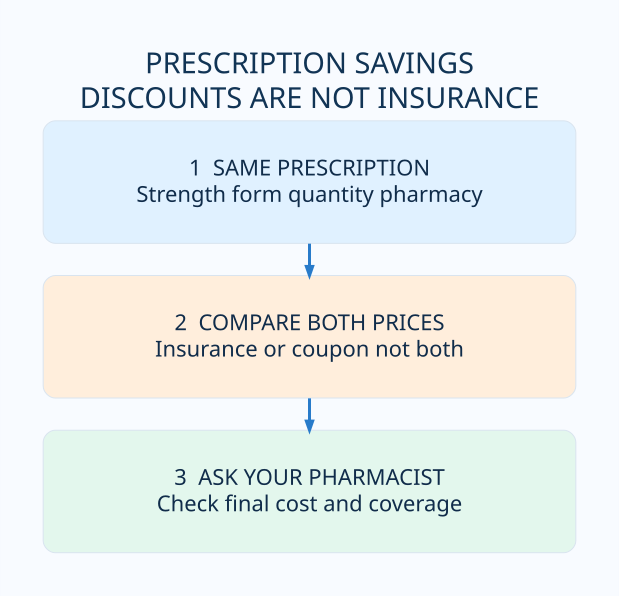
6. Ask the pharmacist these six questions
- Can you quote my plan’s actual copay for this exact prescription?
- What is the ordinary cash price without any coupon?
- Do you accept GoodRx and SingleCare for this particular medicine, and what is the final price for each?
- Is the listed coupon for the right formulation, strength and quantity?
- Will buying outside insurance affect my deductible or other coverage obligations?
- Are there legitimate financial assistance options the pharmacy can identify without changing the prescription?
Frequently asked questions
Can I combine a GoodRx coupon with my insurance copay?
No. GoodRx states that its coupon is used instead of insurance for the same pharmacy transaction, not in combination with it.
Is SingleCare the same as an insurance plan?
No. SingleCare explicitly says that it is a discount program and not insurance. It does not replace an insurance plan’s coverage or benefits.
Does the cheapest coupon always make the most financial sense?
Not necessarily. Consider deductible and coverage consequences, the pharmacy you can use, repeat-fill prices and any membership conditions. Ask your insurance provider for an accurate explanation.
Do discount cards work on every medication and at every pharmacy?
No. Acceptance and product restrictions vary. Verify a specific prescription and pharmacy before traveling or budgeting around a displayed price.
A simple personal comparison worksheet
| Record this detail | Insurance | GoodRx | SingleCare |
|---|---|---|---|
| Exact medicine, strength, form and quantity | Same details | Same details | Same details |
| Final quote at chosen pharmacy | Write amount | Write amount | Write amount |
| Will this count toward my plan deductible? | Ask insurer | Ask insurer | Ask insurer |
| Special account, membership or restrictions? | Plan conditions | Coupon conditions | Coupon and bonus conditions |
Keep health details out of emails or public comments. Use your pharmacy, insurer and prescriber’s secure communication channels for medication-specific questions.
Official sources and disclosure
- GoodRx: Discount Restrictions and Insurance
- GoodRx: Official Terms of Use
- SingleCare: Help and Insurance FAQ
- SingleCare: How to Compare Prescription Coupons
- Medicare: Discount Cards Are Not Drug Coverage
Independent information only: Happy Perks Calendar is not a pharmacy, insurer, coupon provider or medical service. Pricing and eligibility may change. This guide does not replace a clinician’s, pharmacist’s or insurer’s advice.
Share this guide
Know someone who could use these official-source checks? Share the link. Terms and availability may change.

