
FIND UNCLAIMED MONEY
FREE OFFICIAL STATE SEARCH
Reviewed October 11, 2026. Old wages, insurance payments and utility deposits can sometimes become unclaimed property held by a U.S. state. Searching and claiming through an official state program is free. An online name match does not guarantee ownership or a payout. This independent guide explains how to search safely without paying an unnecessary finder fee.
Three reliable starting points
- NAUPA official directory lists state unclaimed-property offices.
- A state treasury or administrator website searches records and processes claims.
- MissingMoney.com covers many participating states, but not all.
What unclaimed property can include
Examples may include uncashed payroll checks, refunds, security deposits, dormant bank funds and insurance proceeds. Each jurisdiction controls its dormancy rules and records. A government-held property record is not the same as a new cash-grant application.
Search each state where you lived or worked
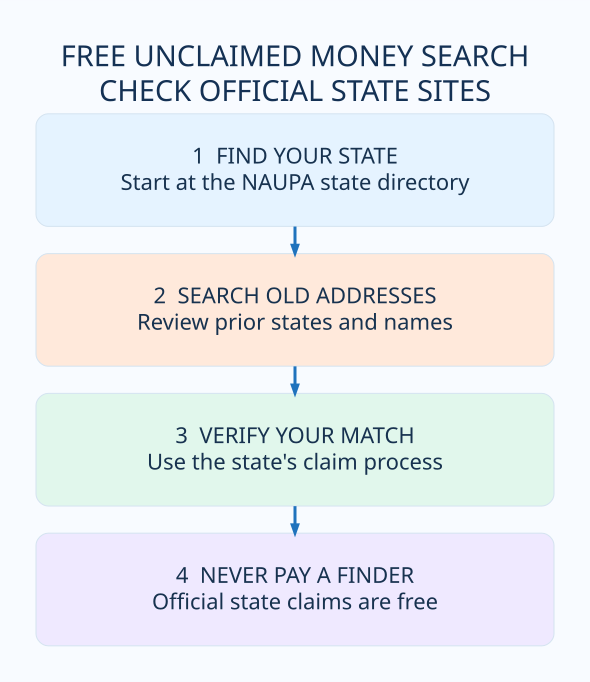
- Visit NAUPA and follow its verified link to your current state.
- Repeat in states where you previously worked, rented housing or maintained accounts.
- Try reasonable variations of your legal and prior names where supported.
- Compare name, reported property holder and former address before claiming.
- Do not upload financial documents or Social Security numbers to an unrelated blog.
NAUPA advises checking each jurisdiction where you lived or did business. Its state contact page identifies the responsible agency.

How an official claim works
- Search the public state directory.
- Identify a plausible result, but do not assume ownership.
- Start a claim through the state’s own secure website.
- Provide only the documents that the state itself requests.
- Keep your official reference number and check the state-administered status.
A legitimate office may require proof of an old address, an account relationship or legal authority over an estate. Processing times and standards vary by jurisdiction. No independent blog can guarantee what the state will approve.
Scam warning signs
- A stranger says a fee must be paid before you can search.
- Someone requests gift cards or cryptocurrency to unlock government-held money.
- A short link imitates the look of a state treasury website.
- An unverified agent guarantees a specific amount before proving ownership.
- The website asks you to send a sensitive ID to a personal email address.
NAUPA explicitly confirms that state searches and claims are free; third-party finders are generally not necessary.
Hypothetical example: forgotten refund
Imagine someone who moved from North Carolina to Illinois and left behind a $95 utility deposit. If an official North Carolina record matches their old address, they can submit the required proof. The state might return funds after approval. The $95 is a hypothetical illustration, not a current record or guaranteed payment.
What a legitimate state request might require
When you submit a possible match, the state program may request specific evidence to verify ownership. Examples can include documents connecting you to a former address, records naming a reported account or inheritance documentation. Each state and asset type has different requirements. Do not submit extra sensitive details before confirming what the official program actually needs.
- Review the claim number and property type within the official portal.
- Read the state’s secure upload or mailing instructions.
- Never email identity documents to a third-party discount website.
- Save confirmation of documents submitted using the official process.
- Ask the state directly if you no longer have documents linked to an old address.
How to compare search results safely
Imagine you moved three times and find a name match connected to an unfamiliar city. That does not establish that the property is yours. Where the database displays details, compare the holder, previous address and relevant financial institution against your own history. Never guess answers to identity questions or treat a partial match as a guaranteed payment.
Some state records do not display the full claimed amount before verification, or group property into categories that need clarification. If you cannot recognize an entry, you can contact the official state unclaimed-property office rather than employing someone who promises to access hidden records for an advance payment.
A privacy-first follow-up plan
- Bookmark your state’s actual treasury website.
- Keep the official claim reference private.
- Check the state portal for status instead of repeatedly filing duplicates.
- Confirm legal documentation rules for inherited or business assets.
- Ask the administrator directly when a claim is delayed or disputed.
- Never regard a third-party promise as official approval.
Questions people ask
Do I need to pay to search? No, use an official state program. Is every similar name a match? No, the state must confirm ownership. Can I claim inherited funds? Possibly, subject to estate evidence requirements. Is this site a claim processor? No; never submit your identity documents here.
A simple annual review
Keep a secure record of prior states, addresses and employers. Check the relevant official state sites once in a while, and follow up with the state directly if you find a plausible record. Avoid paying for advertising, finder memberships or unnecessary third-party services.
More verified savings resources
Use our Deal Reality Check to evaluate misleading payment promises. For location-specific government programs, also see our U.S. home energy rebate guide.
Official sources
Disclosure: Happy Perks Calendar is not affiliated with the state administrators or NAUPA. It does not accept claim applications, government fees or identity documents.
Share this guide
Know someone who could use these official-source checks? Share the link. Terms and availability may change.

